

COEXISTENCE
Wolves are a species that is subject to what Kelly Murphy of the Colorado Wolf and Wildlife Center considers to be the "Big Bad Wolf narrative." However, contrary to popular belief, wolves are only responsible for about 0.2% of all livestock losses. Aside from bear attacks, which account for 0.1% of livestock deaths, wolves are actually the least common cause of death for livestock. Domestic dogs are the third deadliest carnivore in terms of livestock losses, but we don't see ranchers pressuring people to give up their pets for the sake of their own animals.
Aside from the few instances where wolves do attack livestock, ranchers have claimed that simply having wolves in the area stresses out their livestock, causing them to both breed less and weigh less. Ranchers are paid by the pound, so any loss in animals, whether by weight or in whole, can have a significant impact on their total profits. As a result, ranchers frequently employ lethal control tactics to prevent this from occurring. For the sake of both ranchers and wolves, it's worth noting that, over the course of the Wood River Wolf Project's 12-year history, sheep losses in the project area that used nonlethal deterrents rather than lethal ones were 90% lower than in the rest of Idaho, where entire packs of wolves have been killed; when it comes to preventing extinction, even single deaths have a significant impact on the species' population.
This loss of wolves is as damaging as it is because wolves are apex predators that exist in relatively small numbers and have a disproportionately large impact on the ecosystems in which they reside. They change nearly everything in them from the top-down regarding the trophic pyramid.
To elaborate, wolves have been proven to benefit ecosystems in a number of ways, both directly and indirectly, from strengthening the populations of other animals to improving riparian zones. This was concluded when wolves were exterminated in Yellowstone National Park in 1926 and then later reintroduced in 1995. In the case of when there were no wolves in Yellowstone, coyotes assumed the position of being the park's leading predator. They did not cull the sick ungulates in the park seeing as they are smaller than wolves. Instead, they preyed on small mammals, whose tiny carcasses left scavengers starving. Elk and other ungulates populations grew overabundant to such an extreme where they made a significant negative impact on their own environment. Without fear of being hunted, they would congregate in large numbers along streams and overbrowse the plants there, preventing erosion. The park's tree growth was then stunted, and no new trees would grow since their sprouts would all be devoured. As a consequence, streams became shallower and warmer due to the decrease of shade over them, creating a threat to fish and amphibians that rely on a sizable aquatic ecosystem for at least part of their lifetimes. This also reduced the amount of available nesting area for birds and the amount of wood for beavers to build dams with. When wolves were reintroduced, however, ungulate and coyote populations were suddenly culled, small animal populations increased, scavengers and birds had more food, and riparian habitats were stabilized.
This is why ranchers and wolves must peacefully coexist through nonlethal management techniques. Listed below is a series of deterrents that the Wood River Wolf Project tested and found to be 3.5 times more effective than lethal methods in reducing wolf predation on livestock. Working Circle and Kelly Murphy, on behalf of the Colorado Wolf and Wildlife Center, have also offered some of these suggestions. All of these methods rely on wolves' natural caution of people and the world around them.
There are a few things that ranchers should do in order to receive the most effective outcomes possible with these said deterrents. Wolves, like many other animals, will become accustomed to the sounds, motions, and lights that they are habitually exposed to and will no longer be scared by them. Ranchers should vary their deterrents and avoid using them for extended periods of time to prevent this.
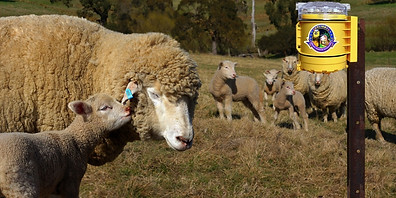


Human Presence
Wolves have learned to avoid humans and can easily detect their scents and voices, so having range riders or people who can go camp with the livestock when wolves are nearby will be extremely effective.
Hazing Devices
Wolfs are scared of loud noises and bright lights, so having a variety of tools to produce them will keep them at bay. Ranchers could install fox lights (as seen in the image above) or motion detection lights, and have people camping or patrolling at night with spotlights or headlamps if wolves are nearby. They could also fire starter pistols, sound air horns, or play music from speakers placed throughout their pastures.
Livestock Guardian Dogs
Ranchers can keep livestock guardian dogs in each of their pastures to protect their animals and scare away any approaching wolves. The Great Pyrenees, Akbash, Anatolian Shepherd, Komondor, and Kuvasz are the best breeds for this job.
Turbo-fladry
Turbo-fladry is cording with evenly spread flags that sit along an electric fence. Wolves are likely to avoid it due to the movement of the flags fluttering in the breeze, but if they investigate it anyway, they will be given a small shock.
Reinforced Pens
Ranchers can protect smaller livestock from wolves by burying mesh hardware cloth beneath their pens (as shown in the image above) and covering them with a deer net or lifting them off the ground. They could also train their smaller animals to stay in their pens and barns all throughout the night.
Reduced Attractants
Reducing overall attractants can also help to minimize wolf predation on livestock. Ranchers could confine their younger, smaller, weaker, and pregnant animals to or near their barns; bury their dead animals, fence them off, or treat them with a taste deterrent; and refuse to feed any wildlife.
Telemetry
Telemetrizing wolves with GPS collars will allow both the range riders and the ranchers to know when a pack is nearby. If they notice that they are getting closer to their livestock than they would want, they can use more of their hazing devices, as described above.

